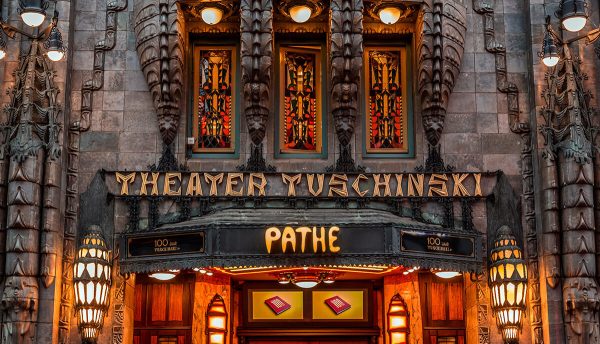
Sometimes you walk past it without looking up. That's a shame, because the facade of Pathé Tuschinski is one of the most distinct pieces of architecture in the center. Glazed tiles, ceramic sculptures, wrought iron decorations and towers that have something oriental without looking uniformly oriental. It opened on Oct. 28, 1921. Construction costs were about four million guilders. That was a huge sum in those days, and it shows.
Behind the theater were three Polish-Jewish entrepreneurs with film passion: Abraham Tuschinski, Hermann Ehrlich and Hermann Gerschtanowitz. Tuschinski was the driving force, the man with the idea and the ambition. Ehrlich and Gerschtanowitz stood beside him. They wanted to build not just any cinema, but something that would touch people as soon as they stepped through the door. Architect Hijman Louis de Jong translated that ambition into a building in a style found nowhere else: Art Deco, Jugendstil and the Amsterdam School mixed together, in a way that deserved its own name. They call it the Tuschinski Art Deco style. The wrought-iron decorations and lamps are the work of Barend Jordens, who accounted for much of the hall's character.
The main hall is the heart of it all. Original hand-knotted carpets with an eagle motif are still there. The balcony is there, the warm colors are there, the gold details are there. When it opened, the theater had a Wurlitzer theater organ and a live film orchestra. Also revolutionary was the heating and ventilation system, something that was by no means a given in 1921. Of all that, the atmosphere remained. A major restoration followed between 1998 and 2002, lasting four years and returning the main hall to its original state. Since then, everything has been running the way it was intended.
Original hand-knotted carpets with an eagle motif are still there, making each visit different than you expect.
All three founders, Tuschinski, Ehrlich and Gerschtanowitz, perished during the Holocaust. That fact hangs invisibly but palpably in the air as you walk around. The building on Reguliersbreestraat is more than a hundred years old and still running. That in itself is something to stop and think about.