In the Grachtengordel stands a building that you actually look at twice. The De Bazel building on Vijzelstraat is imposing, built in a brick expressionist style you won't soon forget. Architect Karel de Bazel designed the building in 1926, originally as the headquarters for what would later become the ABN AMRO Bank. Now it houses something completely different: the Stadsarchief Amsterdam, the memory of the city.
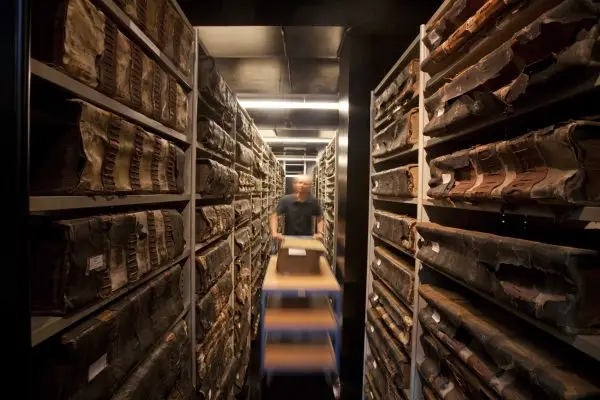
Exactly what that means becomes clear as soon as you hear the numbers. The collection covers 35 kilometers of archival material. Not a typo. Thirty-seven kilometers of documents, images and stories, built up over 750 years. With this, the Stadsarchief covers not only Amsterdam itself, but also Amstelveen, Ouder-Amstel and Diemen. Four municipalities, one archive, a building that looks dignified enough for it.
The imposing exhibition hall is the public side of the archive. Here the City Archives hosts regular exhibitions on the city's history, open to everyone. No entrance fee, no reservation required. Just walk in and look. This is a conscious choice: city history belongs to everyone, not just researchers with a login code.
The collection has 750 years of documents, images and stories, and you can feel it as soon as you walk around.
The collection ranges from medieval charters to twentieth-century photographs, from handwritten deeds to topographic maps. Millions of historical topographical documents are in the collection. This also makes the City Archives relevant to those who are not necessarily historians. Anyone who wants to track down their own family, is curious about an old building in the neighborhood, or just wants to understand how the city became what it is: this is the place to go. The collection has 750 years of documents, images and stories, and you can feel that as soon as you walk around. The De Basel building itself is already worth seeing. But what's inside is even more impressive.