Behind a curtain on Ceintuurbaan sits one of the city's most unusual Japanese restaurants. Ikkoku has no big storefront or busy patio. What it has: a counter, an open fire, and chefs preparing every dish before your eyes. The concept is based on robatayaki, a Japanese cooking technique in which ingredients are prepared at an irori: a traditional open-fire table also known in Japanese as 炉端割烹. You watch, smell the fire, and see your food being created.
The choice is simple. You go for the A5 wagyu omakase menu or the bluefin tuna and seafood omakase menu. Both are made up of several courses. The wagyu menu has fifteen. A5 is the highest quality class for wagyu beef: extremely well-seasoned, tender, full of flavor. The bluefin tuna is the other extreme of the deluxe menu. Fresh ingredients, seasonal, ever-changing. So what you eat also depends on when you go.
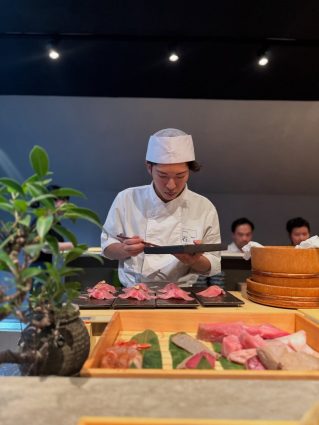
Ikkoku is in the Pijp, a neighborhood long since known not only for Albert Cuyp and brown pubs. The counter arrangement is deliberately kept small. You sit close to the kitchen, close to the fire, close to the chef. Names of the chefs are not made public, but that actually fits the concept: it's about the food and the technique, not the story next to it. The space itself is intimate, literally hidden behind a curtain. Those who first step inside don't know what to expect for a while.
You're close to the kitchen, close to the fire, close to the chef. Names of the chefs are not made public, but that actually fits the concept.
Reservations are made via Instagram DM at the account @ikkoku.ams, which now has more than 8,300 followers. No website, no app, no phone number. Just send a message and agree on when to come. It sounds awkward, but it fits the scale of the business. Ikkoku is not built on volume. It is built on attention: to the fire, to the ingredients, to the guests at the counter. And at that counter, the evening really begins when the curtain closes again.