Museum Vrolik is no ordinary anatomy museum. The collection began as the private collection of Gerard Vrolik (1775-1859), professor of anatomy in Amsterdam, and his son Willem Vrolik (1801-1863). Father and son spent decades stockpiling specimens: human organs, skeletons, congenital anomalies and animal specimens. In 1869, the city of Amsterdam bought up the entire collection.
Willem Vrolik specialized in congenital anomalies and zoology. His work is still visible in the collection: preparations of Siamese twins, malformed skulls, as well as a seal dissection he performed in 1822. In addition to the Vrolik preparations, the museum contains the Hovius cabinet, an 18th-century osteological collection that is among the oldest parts of the whole. And then there are the anatomical drawings by Henriette Blumenthal, a medical illustrator who was commissioned by anatomist Martin Woerdeman to create a complete anatomical atlas for the museum in the 1930s.
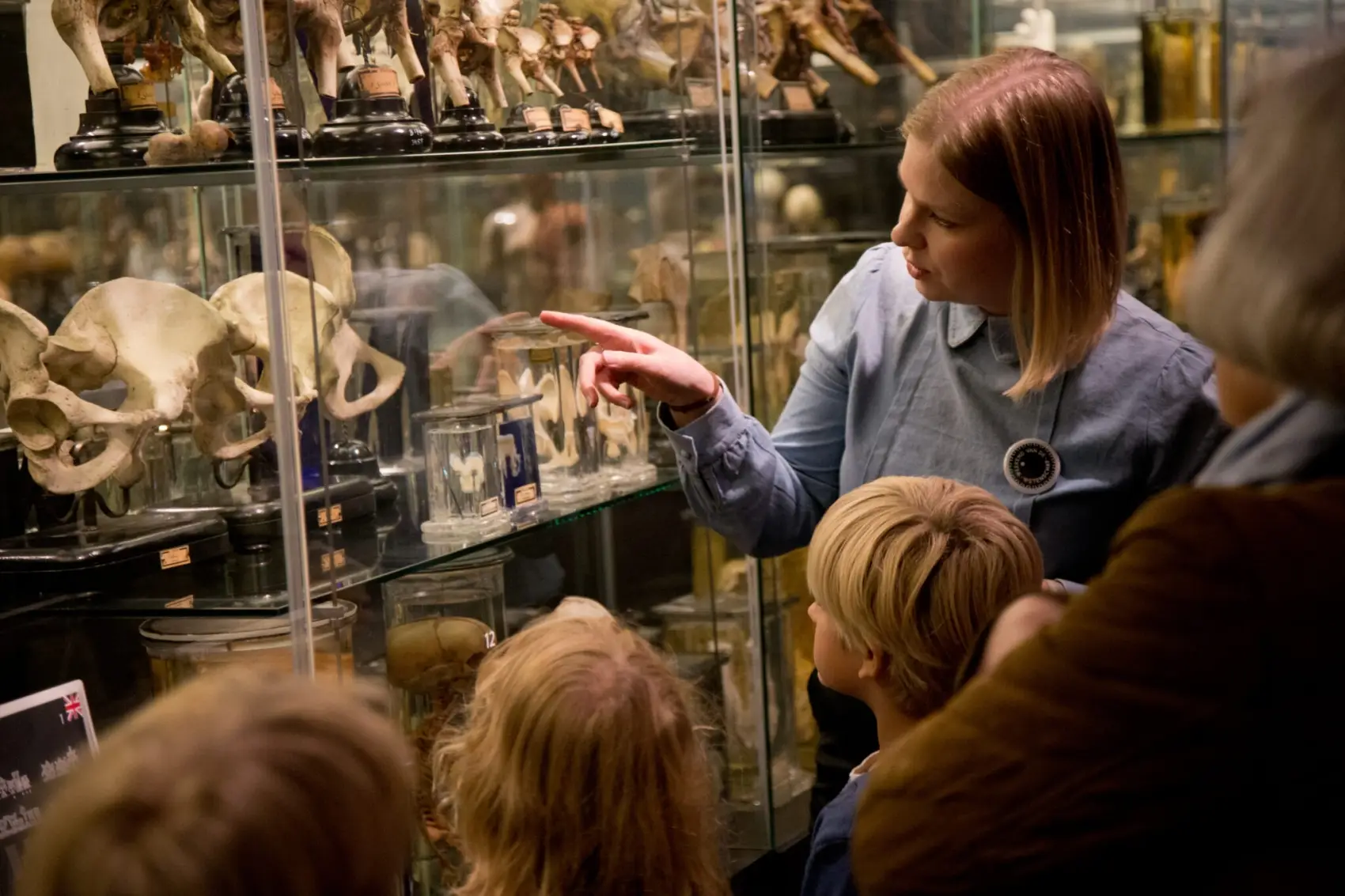
The museum is located in building J0 of Amsterdam UMC, location AMC, in the Meibergdreef neighborhood of Southeast. The space is compact, but the arrangement is tight: showcase after showcase of specimens showing normal anatomical structures such as stomach walls, muscle layers, nerves and blood vessels, interspersed with pieces that should make you think for a moment about what exactly you are looking at. UvA medical students get in for free. It's open to everyone else, too, five days a week.
Fifteen Moluccan ancestral skulls back home, an exhibition on colonial heritage, and 1,200 specimens just waiting: Museum Vrolik is a place that will stay with you.
Accessible by metro or train station Holendrecht, then a short walk to the hospital complex. Parking is also available, in garage P2 of the AMC. The museum is open Monday through Friday. Fifteen Moluccan skulls back home, an exhibition on colonial heritage, and 1,200 specimens just waiting: Museum Vrolik is a place that will stay with you.